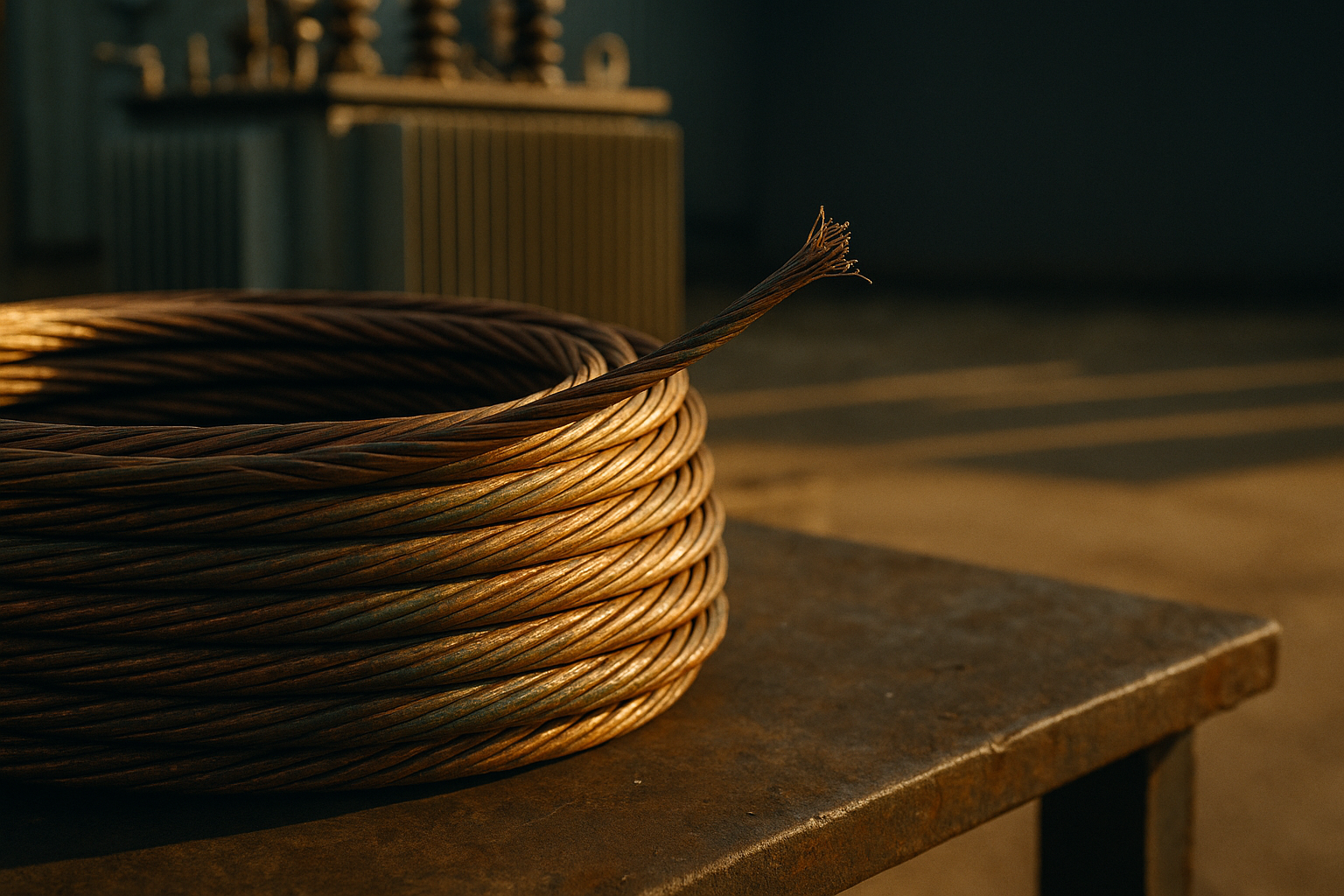
Chile cut its 2026 copper production forecast by 2% and its 2027 forecast by nearly half a million tonnes on the same day Virginia Transformer broke ground on a 600,000-square-foot greenfield plant in Alabama that will not produce its first unit until January 2028. Read together, the two announcements locate the binding constraint on the AI buildout in the wire and the windings between chip fab and power plant, not in either of those two endpoints.
The middle of the stack is where the buildout breaks
Strategy decks on AI infrastructure have largely organised themselves around two anxieties: securing advanced compute, and securing firm power. Both are real. Both are also being addressed with enormous capital, roughly $635 billion in planned 2026 hyperscaler spending per S&P Global figures cited by Reuters [1]. The layer that capital cannot fix on the same timeline is the physical middle: the high-voltage transformers that step generation down to usable site voltage, and the copper that runs through every winding, busbar, and cable on the campus.
Virginia Transformer's own language is instructive. The company describes itself as the largest North American power transformer manufacturer and states plainly that much of current US demand "is being met by imported transformers from overseas" [2]. The Alabama plant is its seventh North American facility. Its Rincon, Georgia site is simultaneously adding 50% to installed capacity, completing March 2027. CEO Prabhat Jain frames the firm's competitive position in terms of "the shortest lead times" in the industry [3]. When the market leader's pitch is that it is the fastest in a slow industry, and its newest greenfield capacity will not ship for thirty-two months, the buildout calendar for everyone downstream is already written.
Chile's downgrade matters more than the headline copper price
The instinct on reading Cochilco's revised forecast is to look at the price: 2026 average now $5.55/lb, up from $4.95, with spot above $6 [4]. The more important line is the volume. Chile produces almost a quarter of the world's mined copper. Its 2027 forecast has been cut by roughly 470,000 tonnes against the prior estimate [5]. Mining Minister Daniel Mas attributes this to lower ore grades, maintenance, and operational constraints [6]. Ore grade decline is not a cyclical problem that price fixes. It is a geological fact that price merely surfaces.
The supply response is also slower than the bull case admits. Goldman Sachs has noted that regulatory approvals for new copper mines are at a fifteen-year low, against development timelines of ten to twenty years per project [7]. S&P Global's estimate for closing the gap, three tier-one mines per year for twenty-nine years, $500 billion in aggregate capital [8], is the kind of number that gets quoted in conference keynotes and ignored in budget meetings. It should not be. It defines the upper bound of what mobilised capital can actually achieve against a fixed permitting and construction calendar.
Why this reframes hyperscaler dependency maps
The strategic error most Fortune 500 teams are making is treating their AI infrastructure exposure as a function of compute allocation and power-contract signings. Those are the visible contracts. The invisible contracts are the transformer order books at Hitachi Energy, Siemens Energy, GE Vernova, and Virginia Transformer, and the long-term copper offtake arrangements buried inside cable and switchgear procurement. A hyperscaler can win the compute auction, sign the power contract, secure the land, and still wait two-plus years for the substation that energises the site.
This has three consequences worth pricing now. First, site-selection economics shift toward locations where transformer slots and copper-intensive switchgear can be sourced, not merely where land and water are available. The brownfield premium rises; campuses inheriting existing substations are worth more than the real estate alone implies. Second, negotiating power inside the AI capex stack migrates upstream. Transformer manufacturers and large electrical contractors gain the same pricing power in 2026 to 2028 that advanced chip suppliers held in 2023 to 2024. Third, vertical integration becomes a defensible move for hyperscalers that can afford it. Expect to see at least one major hyperscaler announce a direct equity stake in a transformer manufacturer or a long-term capacity reservation deal structurally similar to the prepayment models long used in advanced semiconductor supply.
The copper layer compounds this. Cochilco's projection that the refined copper market shows a small 12,000-tonne surplus in 2026, following a 124,000-tonne deficit in 2025 [9], will be cited by bears as evidence the squeeze is overstated. The number is real but the framing is misleading. Refined cathode balance is not the same as fabricated copper availability. A transformer winding, a data-centre busbar, and a high-voltage cable all require copper that has been drawn, rolled, or extruded into specific forms, on order books that are themselves constrained. Surplus at the cathode layer can coexist with shortage at the fabricated-product layer for several years. That gap is where the AI buildout actually transacts.
The counter-case deserves a hearing
The strongest bear argument runs as follows: prices above $6/lb are mobilising mining investment across the DRC, Zambia, Mongolia, Canada and the US [10]; transformer manufacturers are adding greenfield capacity; and McKinsey and others argue that liquid-cooled, higher-density rack designs reduce copper intensity per unit of compute. Cochilco's own 2026 surplus projection appears to corroborate the self-correction story.
It fails on timing rather than on direction. Markets are indeed self-correcting. They are correcting on a five-to-fifteen-year horizon for mining and a three-to-five-year horizon for transformer capacity. Hyperscaler capex commitments are being made on an eighteen-to-thirty-six-month horizon. That mismatch is the entire strategic point. Cochilco's projected 2026 surplus of 12,000 tonnes is a rounding error against 28.2 million tonnes of demand [11], and it disappears entirely if any one of Chile's grade, maintenance, or operational assumptions slips again, as they just did. The density argument has more force on the compute side of the rack than on the substation side; a 500 MVA transformer requires what it requires regardless of how efficiently the silicon downstream uses its electrons. And the geographic concentration of new supply growth in the DRC, Zambia and Mongolia introduces a political-risk discount the bull case rarely prices.
The bear case is right that the constraint resolves. It is wrong about when. The window of acute scarcity is 2026 through 2028, which happens to be exactly the window in which most announced AI infrastructure commitments are scheduled to come online.
What to watch
1. Transformer order-book disclosures from the listed manufacturers. Hitachi Energy, Siemens Energy and GE Vernova report backlog figures quarterly. If aggregate power-transformer backlog growth decelerates below 15% year-on-year in any two consecutive quarters through 2027, the bottleneck thesis is weakening. If it accelerates above 25%, the thesis is hardening and lead times are extending despite new capacity.
2. Cochilco's next quarterly revision, due roughly August 2026. A further downward revision to Chile's 2027 forecast, below the current 5.5 million tonnes, would confirm that the ore-grade and operational headwinds are geological rather than one-off. A revision upward would meaningfully weaken the supply-side leg of this argument.
3. Hyperscaler announcements of direct equity stakes or long-term capacity reservations with transformer manufacturers or copper producers. The first such deal, most plausibly from Microsoft or Amazon given balance-sheet capacity, will confirm that the dependency map has been redrawn internally at the hyperscalers. Absence of any such deal through end-2026 would suggest the constraint is being managed through conventional procurement and the thesis is overstated.
Sources
[4] https://www.mining.com/web/cochilco-raises-2026-copper-price-forecast/
[5] https://www.mining.com/web/chile-lowers-copper-production-outlook-raises-price-forecasts/
[7] https://www.ief.org/news/how-copper-shortages-threaten-the-energy-transition
[8] https://www.ief.org/news/how-copper-shortages-threaten-the-energy-transition
[10] https://www.mining.com/web/cochilco-raises-2026-copper-price-forecast/
[11] https://www.mining.com/web/cochilco-raises-2026-copper-price-forecast/