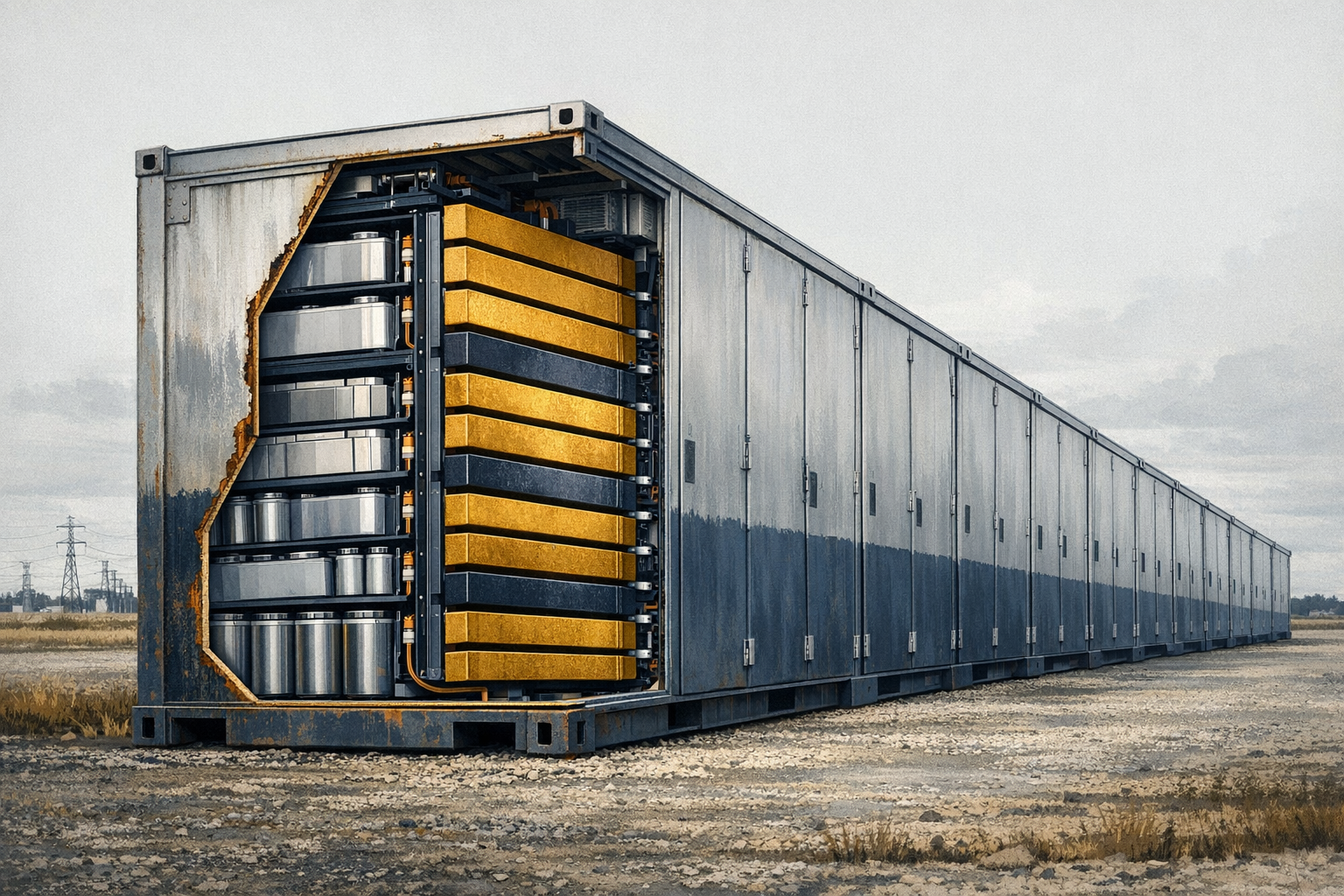
Two announcements landed within 24 hours that, taken together, should reset how serious capital planners think about grid-scale storage. LG Energy Solution's US arm booked a $1.6 billion contract with DTE Energy for 1.5 gigawatts of Michigan storage [1], and Taiwanese solid-state maker ProLogium filed to list on Nasdaq at a $3.8 billion SPAC valuation [2]. The less obvious consequence falls not on storage itself but on who gets to sign the next hyperscaler power deal.
The EV-to-storage pivot
The Lansing facility now supplying Tesla's Megapack 3 cells was originally a $2.6 billion General Motors-LG joint venture for electric vehicle batteries. GM sold its stake to LG in May 2025 [3]. Ford has done the same thing in Kentucky, repurposing an idled EV battery plant under a wholly owned subsidiary called Ford Energy, with 20 GWh of annual storage output planned for 2027 [4]. This is the same pattern twice in successive years: stranded EV capacity redirected into stationary storage, with a contracted customer attached.
The DTE deal is the demand side of the same pivot. Eight projects, 6 GWh, contracted to a single Midwestern utility, with LG's stated North American ESS capacity target of 50 GWh by end of 2026 [5]. Tesla deployed 46.7 GWh of storage in 2025, up from 31.4 GWh in 2024 [6]. The energy segment now generates $12.8 billion of Tesla's revenue, up 27% year on year, and is the only Tesla division growing consistently [7]. The EV demand softness that drove GM to retreat and Ford to idle Glendale has been absorbed by a different customer base: utilities and the hyperscalers behind them.
For corporate planners, the 2027-2028 supply window for grid-scale storage is already being allocated. Tesla has committed over $6.4 billion to Korean suppliers between the LG and Samsung SDI contracts [8]. DTE has taken 6 GWh. Anyone treating storage procurement as a 2028 decision is bidding into a contracted market.
Tariffs and the domestic-only supply curve
The 82.4% tariff on Chinese LFP cells is the load-bearing fact behind every other number in this brief [9]. It turns a Tesla-LG supply contract into a strategic asset rather than a price-shopping exercise. It makes Lansing's converted GM plant valuable rather than stranded. And it makes LG's first-mover position in US-based LFP production a genuine competitive moat. Samsung SDI is behind in Indiana. SK On is further behind. No Chinese alternative survives customs.
Most procurement teams have not absorbed what that means. Storage capex committed in the next several quarters will be priced off a domestic supply curve with three credible cell suppliers. Tesla's CFO has already flagged margin compression in the energy segment from tariff costs [10]; that pressure flows downstream to every utility and data centre operator buying from Tesla. The cost-curve assumptions in most energy transition roadmaps, which still reference global LFP pricing, are wrong for any US deployment. Whether tariffs survive the next trade negotiation is the relevant question; the Tesla-LG contract runs from August 2027 through July 2030 [11], which tells you what one of the most sophisticated buyers thinks the answer is.
ProLogium and Newcleo as a single trade
The ProLogium listing is being read as a battery story. It is more useful read as a capital-markets story about deep-energy infrastructure. On the same day, the nuclear startup Newcleo announced a SPAC deal at a $2.4 billion valuation, described in the Wall Street Journal as part of "a wave of nuclear companies going public to serve AI's surging power needs" [12]. Two listings, two technologies, one common buyer thesis: the public markets are now willing to underwrite pre-commercial energy infrastructure on the expectation that hyperscaler demand is structural.
That thesis has implications beyond either deal. It means the cost of capital for deep-energy bets has fallen even where the technology is unproven. ProLogium's solid-state chemistry remains pre-commercial. Its Dunkirk factory has uncertain offtake. None of that prevented a $3.8 billion valuation. The market is repricing the option value of any energy technology that can plausibly serve AI data centre load. For incumbent lithium-ion suppliers including LG, this is a competitive warning rather than an existential one. Solid-state will not displace LFP for stationary storage on a 2027 timeline. But the threat now has a public ticker, which means it will have public earnings calls, public capex disclosures, and public benchmarking against LG's margins.
For hyperscaler procurement teams the practical consequence is different. The cloud providers can now hedge their power strategy by taking direct equity positions in suppliers like ProLogium and Newcleo. Expect that to happen within twelve months.
The counter-case
The serious sceptical argument runs as follows. The DTE contract is one regional utility deal. The $1.6 billion headline figure traces back to a Yonhap News report, not a primary deal document. Eight Michigan projects have unknown status in the state's grid interconnection queue, which in many US markets now runs five to seven years. The ProLogium SPAC is a capital event, not a production milestone, and Stanford Law's Klausner has documented that SPAC-listed companies routinely trade below NAV within twelve months. The storage sector has produced false dawns before, including the flow-battery hype cycle and the SunEdison collapse. Reading two reinforcing announcements as a structural inflection is the kind of pattern-matching that produces capital misallocation.
That argument is worth engaging; the conclusion it reaches is wrong. The relevant evidence is not these two deals in isolation. It is these two deals layered on top of the $4.3 billion Tesla-LG Lansing contract, the $2.1 billion Tesla-Samsung Indiana contract, Ford Energy's 20 GWh Kentucky build, LG's 50 GWh North American capacity target, and a tariff structure that makes domestic supply economically necessary rather than politically preferred. Each piece in isolation is contestable. Together they describe a contracted demand curve through 2030 that does not depend on either the DTE deal closing on time or ProLogium reaching commercial scale. If both signals proved hollow tomorrow, the underlying capex commitments would still stand. Two data points do not make an inflection; the dozen data points behind them do.
Execution risk is real and worth pricing. LG's pivot from NMC pouch cells to LFP prismatic cells at Lansing is acknowledged as technically non-trivial, with mass production not expected until the second half of 2027 [13]. A slip there reshapes Tesla's 2028 storage revenue. But execution risk on a contracted supply ramp is a different category of problem from demand risk, and most planners are still mispricing the demand.
What to watch
- Hyperscaler-utility storage contracts named in disclosure by Q1 2027. If Microsoft, Google, or Amazon discloses a direct or indirect long-duration storage offtake of more than 1 GW in 10-K or capex commentary, the procurement pattern has moved from utility-mediated to direct. If no such disclosure appears by Q2 2027, the hyperscaler-storage thesis is overstated and storage remains a utility procurement story.
- ProLogium share price relative to NAV at the six-month mark post-listing. If shares trade above NAV at six months with disclosed offtake agreements from at least one automaker or hyperscaler, public capital for pre-commercial energy infrastructure is genuinely open. If shares trade below NAV with no new offtake disclosed, the SPAC window for deep-energy bets is closing and Newcleo and its successors will struggle to raise follow-on capital.
- Michigan regulatory filings on the eight DTE storage projects by end of 2026. If all eight projects appear in state regulatory filings with interconnection studies underway, the 6 GWh number is real and 2028-2029 commissioning is plausible. If fewer than five projects have filed by year-end, the headline contract figure is running ahead of grid reality, and the sceptical case on premature capital allocation gets stronger.
Sources
- https://www.cnbc.com/2026/05/28/lg-energy-solution-dte-energy-michigan-battery-storage-deal.html
- https://www.autonews.com/ev/batteries/ane-prologium-public-offer-0527/
- https://electrek.co/2026/03/17/tesla-lg-energy-solution-4-3-billion-lfp-battery-deal-megapack-confirmed/
- https://www.indexbox.io/blog/ford-repurposes-kentucky-ev-battery-plant-for-energy-storage-systems-1/
- https://www.cnbc.com/2026/05/28/lg-energy-solution-dte-energy-michigan-battery-storage-deal.html
- https://electrek.co/2026/03/17/tesla-lg-energy-solution-4-3-billion-lfp-battery-deal-megapack-confirmed/
- https://www.cnbc.com/2026/03/17/tesla-to-buy-4-point-3-billion-lg-energy-battery-cells-made-in-michigan.html
- https://electrek.co/2026/03/17/tesla-lg-energy-solution-4-3-billion-lfp-battery-deal-megapack-confirmed/
- https://electrek.co/2026/03/17/tesla-lg-energy-solution-4-3-billion-lfp-battery-deal-megapack-confirmed/
- https://www.cnbc.com/2026/03/17/tesla-to-buy-4-point-3-billion-lg-energy-battery-cells-made-in-michigan.html
- https://electrek.co/2026/03/17/tesla-lg-energy-solution-4-3-billion-lfp-battery-deal-megapack-confirmed/
- https://www.wsj.com/business/energy-oil/nuclear-power-startup-newcleo-to-go-public-in-spac-deal-f3761f22
- https://electrek.co/2026/03/17/tesla-lg-energy-solution-4-3-billion-lfp-battery-deal-megapack-confirmed/